Foundations of Organic Chemistry Chapter 5: Electron Flow
Chapter 5: Electron Flow
Following the Electrons
Estimated reading time: 3 min
In this chapter
- Introduction
- Why Electron Flow Matters
- Curved Arrows
- Electron-Rich and Electron-Poor Regions
- Nucleophiles and Electrophiles
- Nucleophiles
- Electrophiles
- Bond Formation and Bond Breaking
- Simple Examples of Electron Flow
- Proton Transfer
- Lewis Acid-Base Interactions
- Simple Additions
- Themes That Reappear
- Self-Assessment
- Further Study
- Reading
- Videos
- Looking Ahead
Introduction
Organic chemistry is often described as the study of reactions and transformations.
Underlying these processes is the movement of electrons.
Electrons determine:
- how bonds form,
- how bonds break,
- and how molecules interact.
Learning to follow electrons is one of the most important skills in organic chemistry.
Although reactions may initially appear diverse and complicated, many can be understood by recognizing recurring patterns of electron movement.
Throughout this chapter, the emphasis is not on memorizing reactions but on understanding how electrons behave and how their movement explains chemical change.
Why Electron Flow Matters
Electrons govern:
- bonding,
- reactivity,
- stability,
- and molecular structure.
Understanding electron flow helps connect many of the ideas encountered in earlier chapters, including:
- functional groups,
- resonance,
- acids and bases,
- and stereochemistry.
Electron movement provides a framework for understanding how these concepts influence chemical behavior.
Curved Arrows
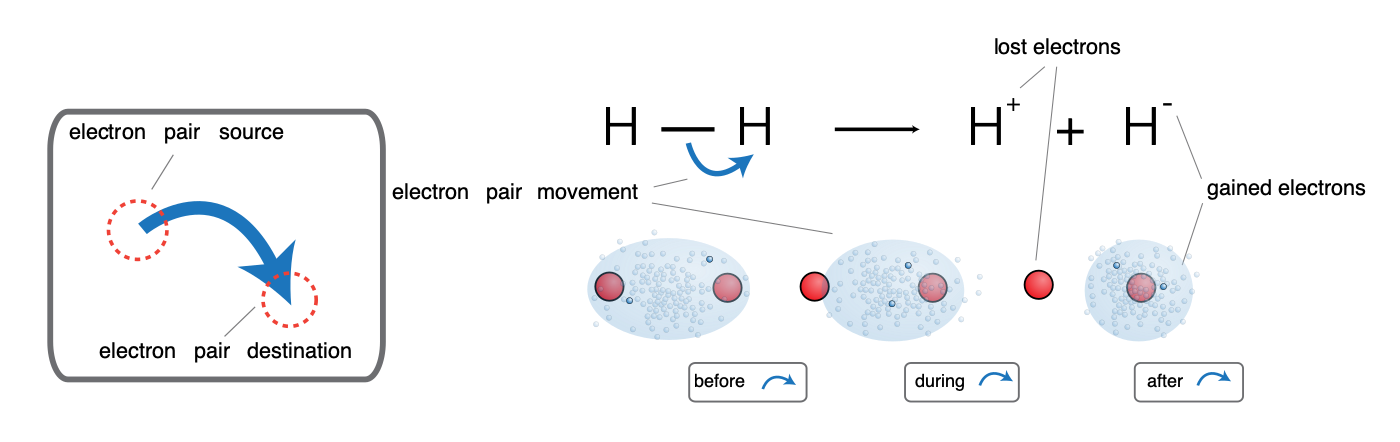
Organic chemists use curved arrows to represent the movement of electrons.
Curved arrows do not indicate the movement of atoms.
Instead, they show how electrons are redistributed during chemical processes.
Learning to interpret curved arrows is similar to learning the grammar and syntax of a new language.
Electron-Rich and Electron-Poor Regions
Electrons are not distributed uniformly within molecules.
Some regions possess relatively high electron density.
Others are relatively electron deficient.
These differences help explain why molecules interact with one another and why certain reactions occur.
Understanding electron density provides insight into:
- polarity,
- reactivity,
- and stability.
Nucleophiles and Electrophiles
Many reactions involve interactions between electron-rich and electron-poor species.
Nucleophiles
Nucleophiles donate electrons.
Common examples include:
- hydroxide,
- water,
- ammonia,
- and molecules possessing lone pairs.
Electrophiles
Electrophiles accept electrons.
Common examples include:
- carbocations,
- positively charged species,
- and polarized atoms within molecules.
These interactions appear repeatedly throughout organic chemistry.
Bond Formation and Bond Breaking
Chemical reactions involve changes in bonding.
New bonds form when electrons are shared.
Existing bonds break when electrons are redistributed.
Understanding how electrons move during these processes provides a foundation for understanding more complicated reactions.
Simple Examples of Electron Flow
Many familiar processes involve electron movement.
Examples include:
Proton Transfer
Acid-base reactions involve the transfer of protons and accompanying electron movement.
Lewis Acid-Base Interactions
Electron pairs are donated and accepted.
Simple Additions
Electron-rich species interact with electron-poor regions.
Although these examples are simple, they illustrate patterns that reappear throughout organic chemistry.
Themes That Reappear
Throughout organic chemistry, several ideas repeatedly influence electron movement:
- resonance,
- acidity and basicity,
- electronegativity,
- charge,
- and stability.
These principles help explain why electrons move in particular ways.
Self-Assessment
I can:
☐ Interpret curved arrows.
☐ Recognize electron-rich and electron-poor regions.
☐ Distinguish nucleophiles from electrophiles.
☐ Understand how bonds form and break.
☐ Appreciate the importance of electron movement in organic chemistry.
Further Study
Reading
LibreTexts Organic Chemistry — Ch. 6, An Overview of Organic Reactions — Reaction mechanisms; curved-arrow notation.
Videos
Khan Academy — Resonance and Acid-Base Chemistry — Curved arrows; electron-pushing.
Continue practicing:
- resonance structures,
- acid-base reactions,
- and curved-arrow notation.
These ideas provide the foundation for understanding reaction mechanisms.
Looking Ahead
Electrons determine how molecules interact.
The next part explores how these interactions combine to produce chemical transformations.
Reaction mechanisms provide a framework for understanding how molecules change and why particular reaction pathways are favored.
Common Mistake — Following Atoms Instead of Electrons
Common Mistake — Memorizing Reactions Without Understanding Electron Flow
Common Mistake — Treating Curved Arrows as Decorations