Mechanistic Thinking Chapter 8: Elimination Reactions
Chapter 8: Elimination Reactions
Building Double Bonds
Estimated reading time: 3 min
In this chapter
- Introduction
- The Big Idea
- E2 Reactions
- A Concerted Mechanism
- Characteristics
- Preferred Substrates
- Why It Happens
- E1 Reactions
- A Stepwise Mechanism
- Characteristics
- Preferred Substrates
- Similarity to SN1
- Comparing E1 and E2
- Competition Between Pathways
- Thinking About Elimination
- Gentle Exercises
- Self-Assessment
- Further Study
- Reading
- Videos
- Looking Ahead
Introduction
Elimination reactions remove atoms or groups from molecules and create double bonds.
These reactions are closely related to substitution reactions and often compete with them.
Two mechanisms dominate:
- E2
- E1
Understanding their similarities and differences helps organize much of Organic Chemistry I.
The Big Idea
Instead of replacing one group with another, elimination reactions remove atoms and generate π bonds.
E2 Reactions
A Concerted Mechanism
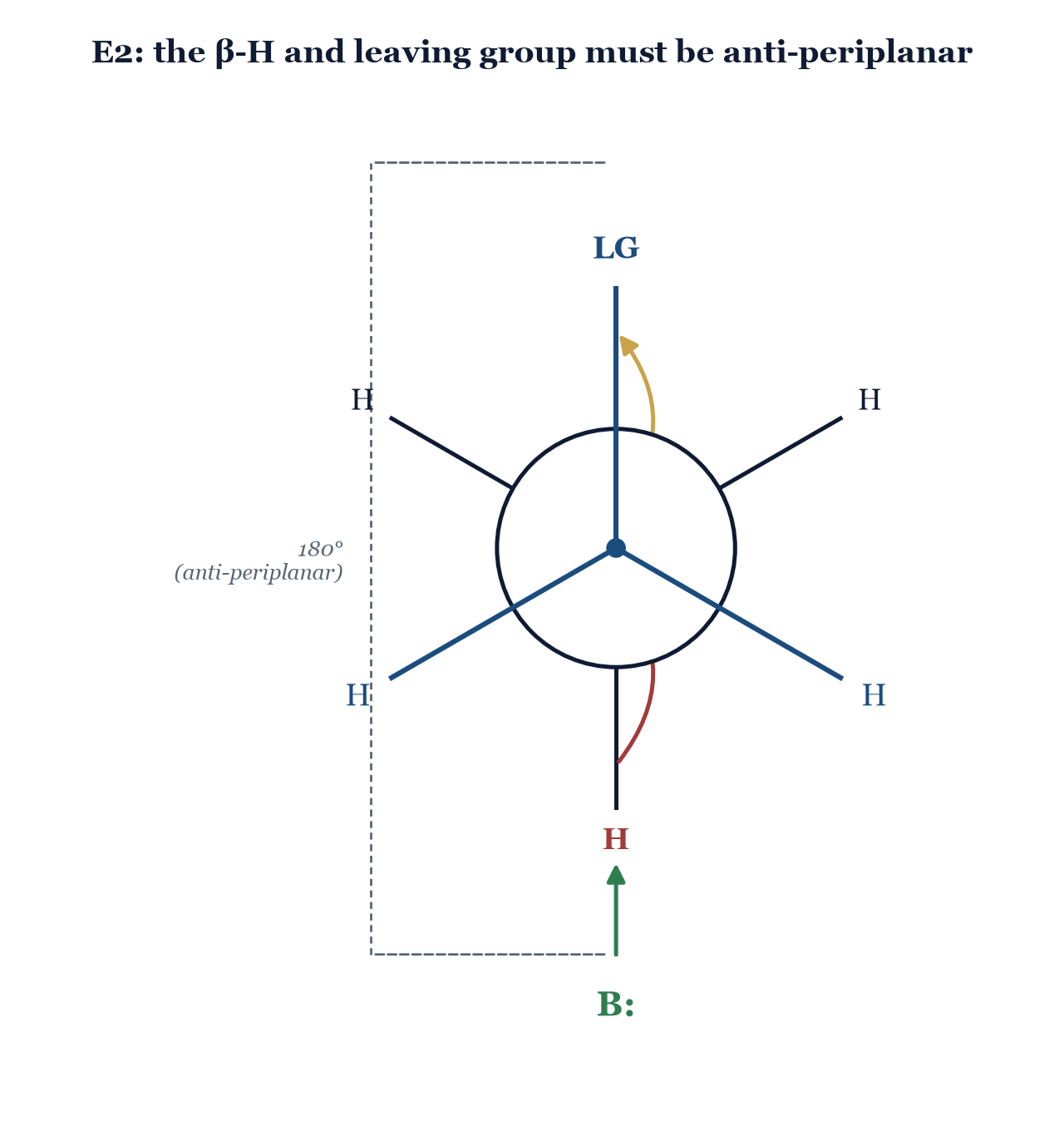
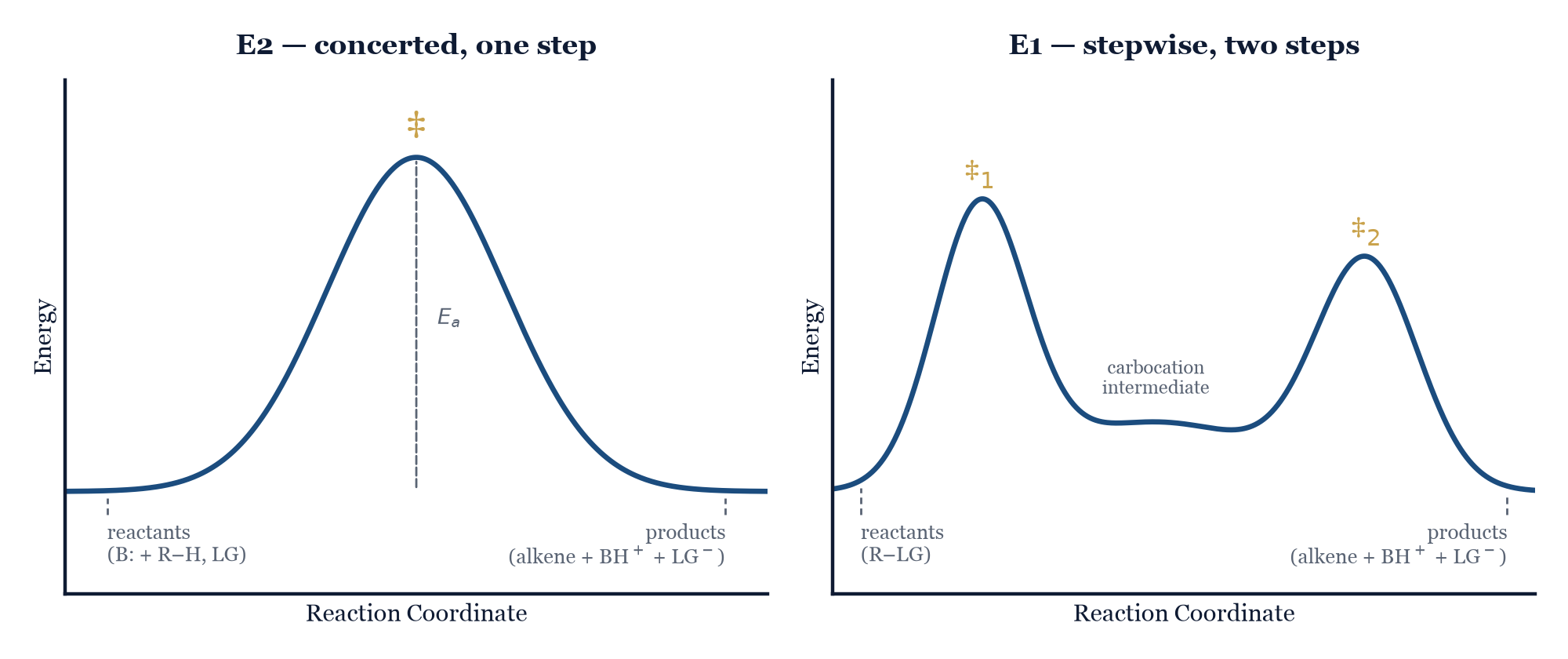
Bond formation and bond breaking occur simultaneously. No intermediates are formed.

Characteristics
- One-step mechanism.
- Strong bases required.
- No carbocation intermediate.
- Anti-periplanar geometry important.
Preferred Substrates
Best: tertiary, secondary. Possible: primary (with a bulky, non-nucleophilic base such as tert-butoxide, which favors elimination over SN2).
Why It Happens
Strong bases remove protons while leaving groups depart.
E1 Reactions
A Stepwise Mechanism
The leaving group departs first. A carbocation intermediate forms. Elimination occurs afterward.

Characteristics
- Two-step mechanism.
- Weak bases acceptable.
- Carbocation intermediate.
- Rearrangements possible.
Preferred Substrates
Best: tertiary. Possible: secondary.
Similarity to SN1
E1 and SN1 reactions share carbocation intermediates and often occur under similar conditions.
Comparing E1 and E2
| Feature | E2 | E1 |
|---|---|---|
| Mechanism | One-step | Two-step |
| Intermediate | None | Carbocation |
| Base | Strong | Weak acceptable |
| Rearrangements | No | Possible |
| Preferred substrate | Secondary and tertiary | Tertiary |
Competition Between Pathways
Many reactions can proceed through substitution, elimination, or mixtures of both.
The outcome depends upon:
- substrate structure,
- nucleophile strength,
- base strength,
- solvent,
- temperature.
Understanding this competition is one of the central themes of Organic Chemistry I.
Thinking About Elimination
Helpful questions include:
- Is a strong base present?
- Can a carbocation form?
- Is elimination favored over substitution?
Gentle Exercises
Determine: whether E1 or E2 is favored; whether substitution may compete.
Self-Assessment
I can:
☐ Distinguish E1 and E2.
☐ Understand carbocation intermediates.
☐ Appreciate the importance of strong bases.
☐ Understand competition with substitution.
Further Study
Reading
LibreTexts Organic Chemistry — Ch. 11, Substitution and Elimination — E1 and E2 mechanisms.
Videos
Organic Chemistry Tutor — E1 vs. E2 comparisons.
Looking Ahead
Elimination reactions create double bonds. These double bonds become sites of reactivity and give rise to addition reactions.
Common Mistake — Treating E1 and E2 as Isolated Reactions
Common Mistake — Forgetting the Geometric Requirements of E2