Mechanistic Thinking Chapter 7: Substitution Reactions
Chapter 7: Substitution Reactions
Replacing One Group with Another
Estimated reading time: 3 min
In this chapter
- Introduction
- The Big Idea
- SN2 Reactions
- A Concerted Mechanism
- Characteristics
- Preferred Substrates
- Why It Happens
- SN1 Reactions
- A Stepwise Mechanism
- Characteristics
- Preferred Substrates
- Why It Happens
- Comparing SN1 and SN2
- Thinking About Substitution
- Gentle Exercises
- Self-Assessment
- Further Study
- Reading
- Videos
- Supplementary
- Looking Ahead
Introduction
Substitution reactions are among the first major reaction families encountered in Organic Chemistry I.
In these reactions, one atom or group is replaced by another.
Although many variations exist, two mechanisms dominate:
- SN2
- SN1
Understanding the differences between these mechanisms represents one of the most important milestones in the course.
The Big Idea
Both SN1 and SN2 accomplish the same overall transformation:
One group leaves. Another group takes its place.
The difference lies in how the replacement occurs.
SN2 Reactions
A Concerted Mechanism
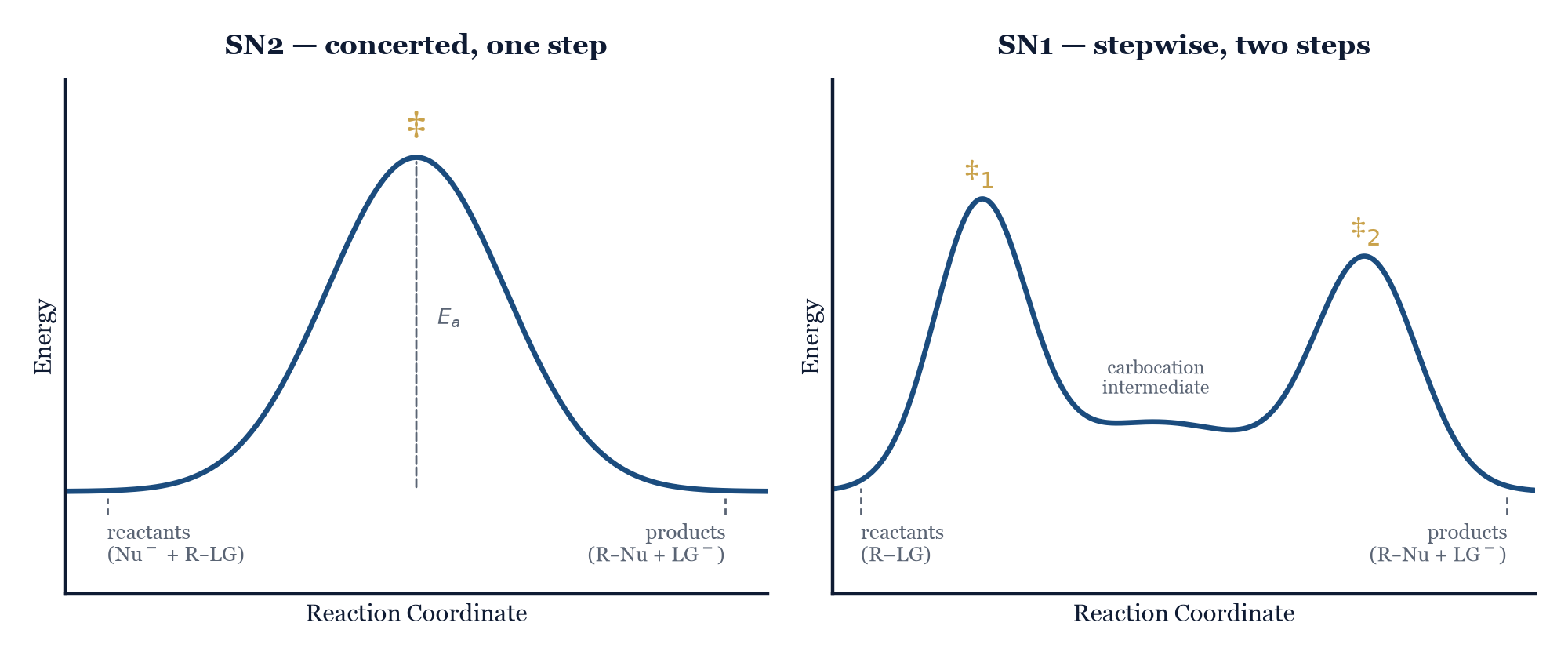
In an SN2 reaction, bond formation and bond breaking occur simultaneously. There are no intermediates.

Characteristics
- One-step mechanism.
- Strong nucleophiles favored.
- Polar aprotic solvents preferred.
- Inversion of stereochemistry.
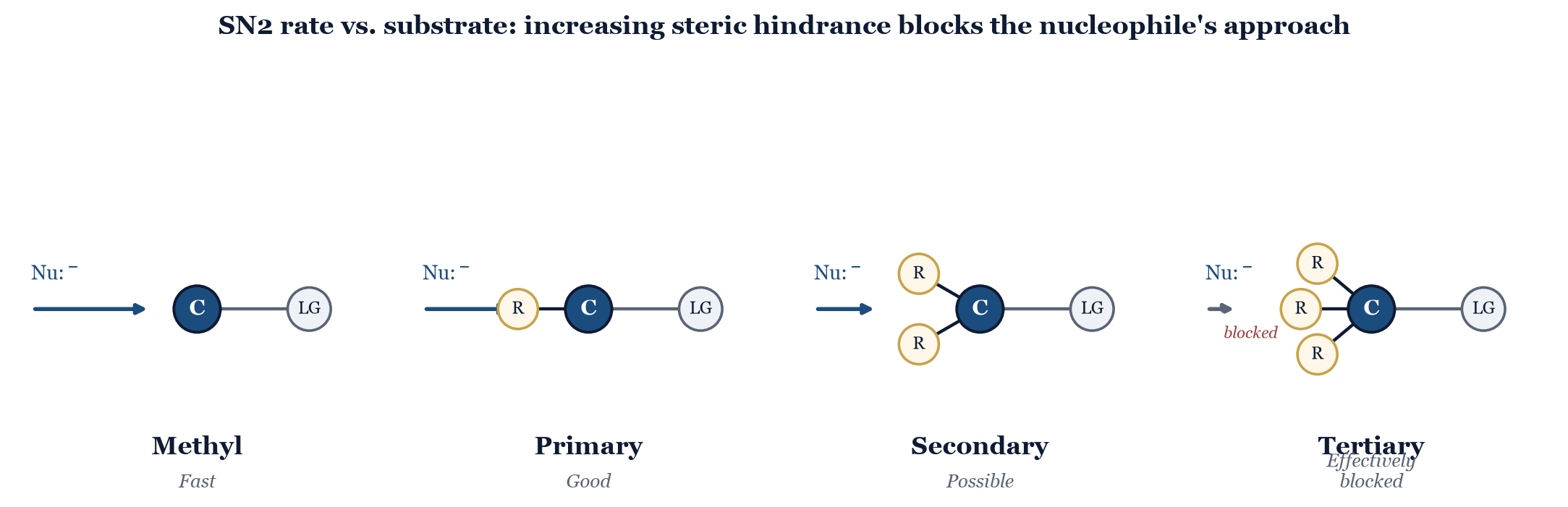
- Sensitive to steric hindrance.
Preferred Substrates
Best: methyl, primary. Possible: secondary. Poor: tertiary.
Why It Happens
Steric crowding affects the ability of the nucleophile to approach the reactive carbon.
SN1 Reactions
A Stepwise Mechanism
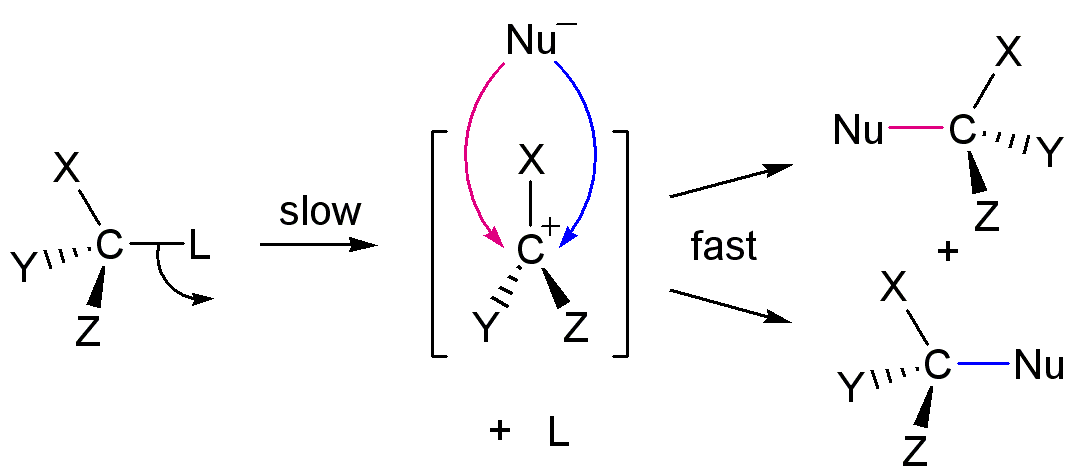
The leaving group departs first. A carbocation intermediate forms. The nucleophile attacks afterward.
Characteristics
- Two-step mechanism.
- Weak nucleophiles acceptable.
- Polar protic solvents favored.
- Carbocation intermediate.
- Racemization possible.
Preferred Substrates
Best: tertiary. Possible: secondary. Poor: methyl, primary.
Why It Happens
Carbocation stability determines whether the reaction is favorable.

Comparing SN1 and SN2
| Feature | SN2 | SN1 |
|---|---|---|
| Mechanism | One-step | Two-step |
| Intermediate | None | Carbocation |
| Nucleophile | Strong | Weak acceptable |
| Solvent | Polar aprotic | Polar protic |
| Preferred substrate | Primary | Tertiary |
| Stereochemistry | Inversion | Racemization (often partial) |
Thinking About Substitution
Helpful questions include:
- How crowded is the reactive carbon?
- Is a carbocation stable?
- How strong is the nucleophile?
- What solvent is present?
Gentle Exercises
Identify: nucleophile, leaving group, substrate type.
Predict: whether SN1 or SN2 is more likely.
Self-Assessment
I can:
☐ Distinguish SN1 and SN2.
☐ Explain carbocation stability.
☐ Appreciate steric hindrance.
☐ Understand stereochemical consequences.
Further Study
Reading
LibreTexts Organic Chemistry — Ch. 11, Substitution and Elimination — SN1 and SN2 mechanisms.
Videos
Organic Chemistry Tutor — SN1 vs. SN2 comparisons.
Supplementary
Master Organic Chemistry — Comparing the SN1 and SN2 Reactions — Substrate, nucleophile, and solvent effects on mechanism.
Looking Ahead
Substitution reactions replace groups. Another major reaction family removes groups entirely.
These elimination reactions introduce E1 and E2 mechanisms and lead to the formation of multiple bonds.
Common Mistake — Memorizing Tables
Common Mistake — Ignoring Solvents
Common Mistake — Overlooking Stereochemical Consequences