Spectroscopy Chapter 20: Mass Spectrometry and Structure Determination
Chapter 20: Mass Spectrometry and Structure Determination
Solving Molecular Puzzles
Estimated reading time: 2 min
In this chapter
Introduction
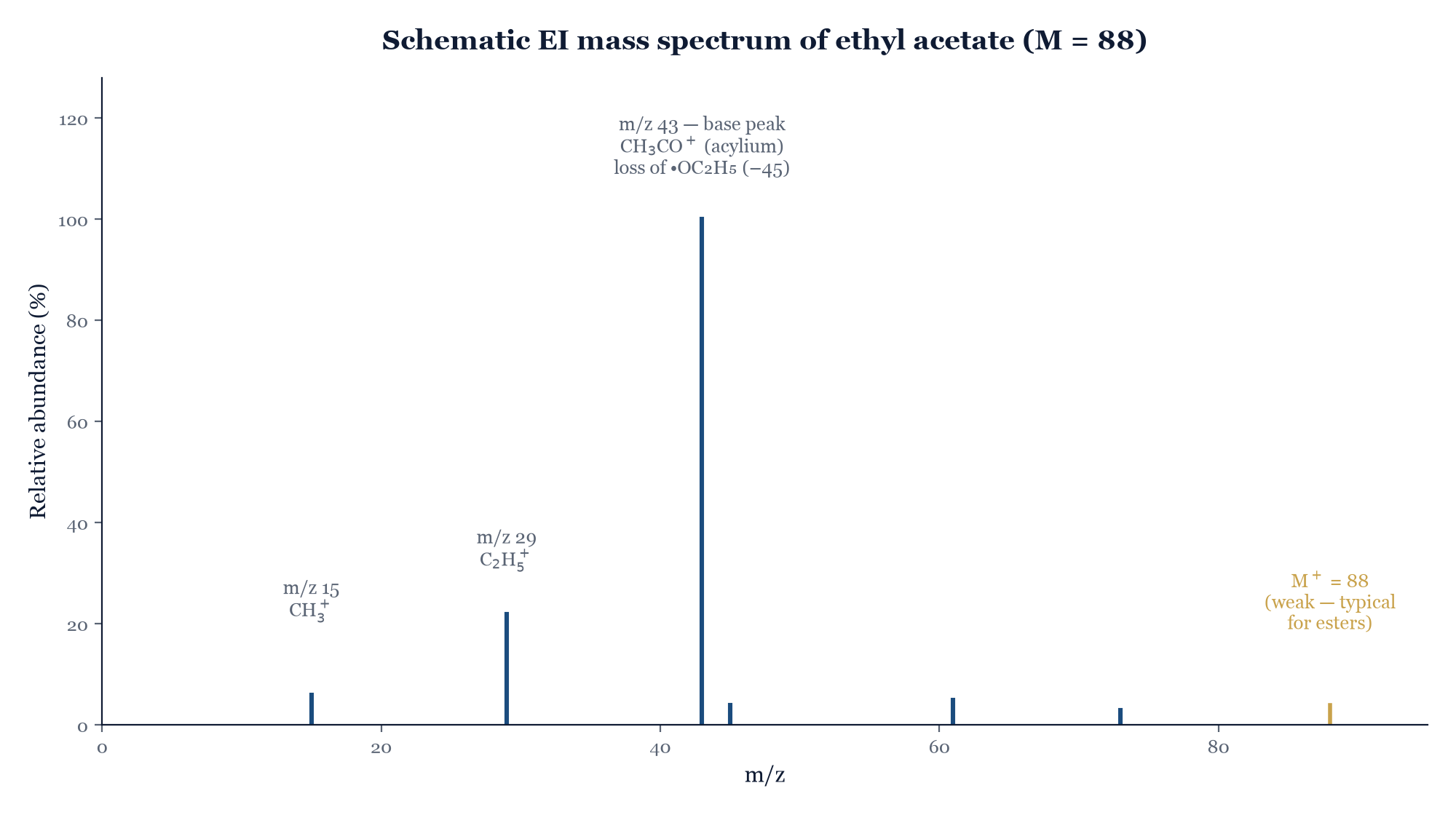
Mass spectrometry provides information about molecular mass and fragmentation patterns.
Combined with infrared and NMR spectroscopy, mass spectrometry allows chemists to determine molecular structures.
The process resembles solving a puzzle in which multiple pieces of evidence must be integrated.
Molecular Mass
Mass spectrometry provides clues regarding:
- molecular weight,
- isotopic patterns,
- and fragmentation.
These features help narrow structural possibilities.
Combining Evidence
Experienced chemists rarely rely upon a single technique.
Instead, they integrate:
Infrared Spectroscopy
Functional groups.
Proton NMR
Hydrogen environments.
Carbon NMR
Carbon environments.
Mass Spectrometry
Molecular mass and fragmentation.
Together, these methods provide a remarkably powerful framework for determining molecular structure.
Structure Determination
Beginning students often view spectroscopy as a collection of unrelated techniques.
Experienced chemists treat spectroscopy as a process of assembling evidence.
The goal is not memorization but interpretation.
Themes That Reappear
Throughout spectroscopy, familiar ideas continue to appear:
- functional groups,
- symmetry,
- structure,
- pattern recognition,
- and intuition.
Organic chemistry repeatedly revisits the same principles from new perspectives.
Self-Assessment
I can:
☐ Explain what mass spectrometry reveals about a molecule.
☐ Recognize the role of fragmentation in structure determination.
☐ Combine IR, NMR, and MS evidence into a single structural proposal.
Looking Ahead
Spectroscopy reveals what molecules are.
The final part of the handbook explores how chemists decide what molecules should become.
This shift from analysis to design introduces retrosynthesis, strategy, and the art of molecular construction.
Common fragment losses and diagnostic ions are collected in Appendix D.
Common Mistake — Treating Spectroscopic Techniques Separately
Common Mistake — Expecting Immediate Answers