Spectroscopy Chapter 19: Nuclear Magnetic Resonance Spectroscopy
Chapter 19: Nuclear Magnetic Resonance Spectroscopy
Understanding Molecular Environments
Estimated reading time: 1 min
In this chapter
Introduction
Nuclear magnetic resonance spectroscopy is one of the most powerful tools available for studying organic molecules.
Unlike infrared spectroscopy, which focuses primarily on bonds and functional groups, NMR provides information about the environments experienced by individual atoms.
NMR allows chemists to reconstruct molecular structures with remarkable precision.
Proton NMR
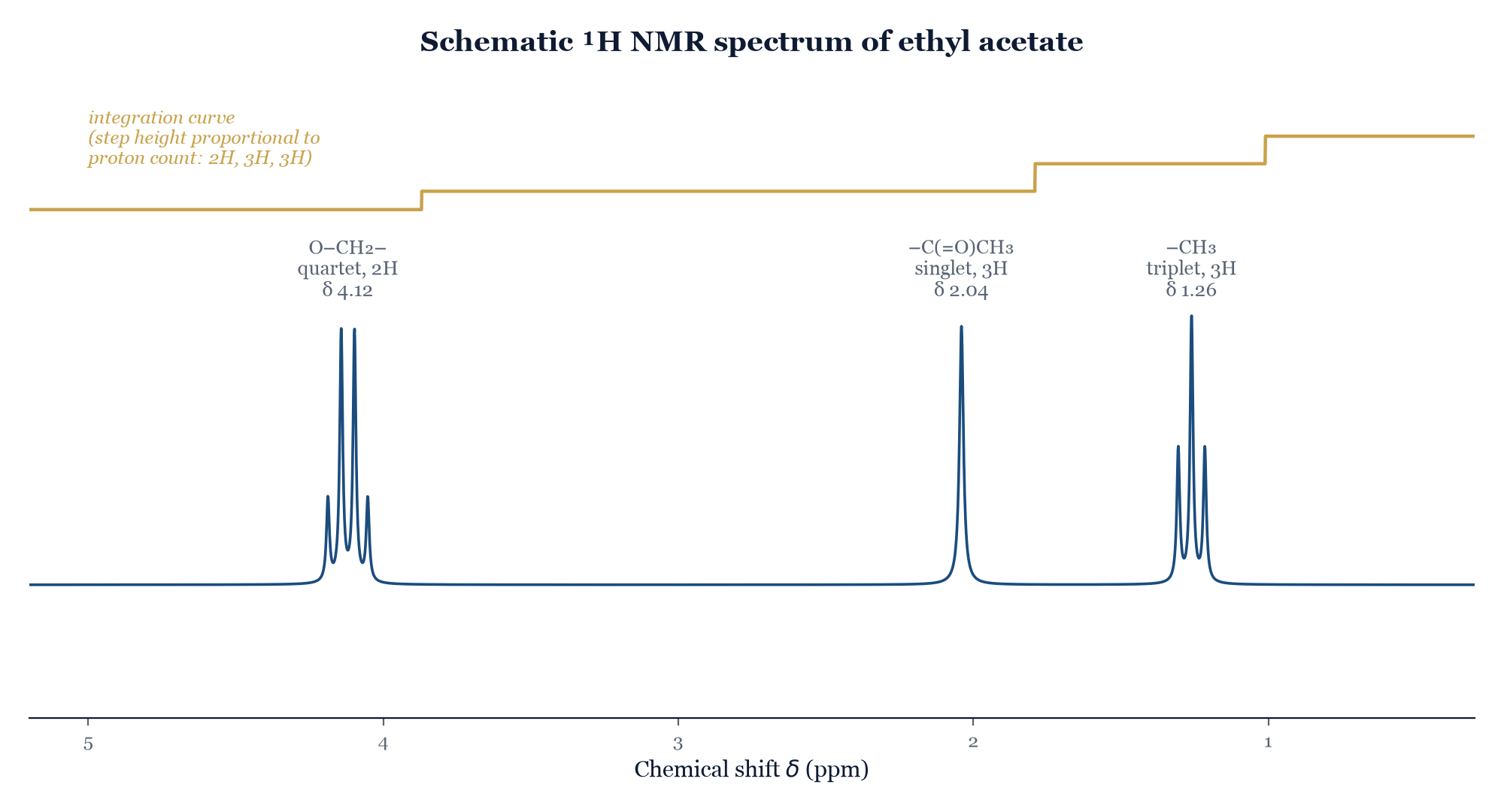
Proton NMR provides information about:
- chemical environments,
- neighboring atoms,
- and relative numbers of hydrogens.
Three ideas become especially important:
Chemical Shift
Where signals appear.
Integration
Relative numbers of hydrogens.
Splitting Patterns
Relationships between neighboring atoms.
Carbon NMR
Carbon-13 NMR complements proton NMR by providing information about carbon environments.
Together, proton and carbon NMR provide powerful structural insights.
Pattern Recognition
Interpreting NMR spectra involves recognizing recurring patterns.
As familiarity grows, spectra become increasingly meaningful.
Much of expertise develops through repeated exposure.
Thinking About NMR
Helpful questions include:
- How many unique environments exist?
- What do chemical shifts suggest?
- Which atoms are neighbors?
- Does the proposed structure fit the evidence?
Self-Assessment
I can:
☐ Distinguish chemical shift, integration, and splitting as separate questions.
☐ Explain what carbon-13 NMR adds beyond proton NMR.
☐ Use neighboring-proton relationships to interpret splitting patterns.
Looking Ahead
Spectroscopy becomes even more powerful when multiple techniques are combined.
Representative chemical shift ranges and splitting patterns are collected in Appendix D.
Common Mistake — Confusing Chemical Shift with Integration
Common Mistake — Treating Signals Independently