Carbonyl Chemistry Chapter 12: Carbonyl Compounds and Nucleophilic Addition
Chapter 12: Carbonyl Compounds and Nucleophilic Addition
The Electrophilic Carbon
Estimated reading time: 2 min
In this chapter
Introduction
Among all functional groups encountered in organic chemistry, carbonyl compounds are among the most important.
The carbonyl group appears in:
- aldehydes,
- ketones,
- carboxylic acids,
- esters,
- amides,
- and many biological molecules.
Understanding carbonyl chemistry begins with understanding the nature of the carbonyl bond itself.
Why Carbonyl Groups Matter
The carbon-oxygen double bond is polarized.
Oxygen attracts electron density, leaving the carbon partially positive.
As a result:
- oxygen behaves relatively electron-rich,
- carbon behaves relatively electron-poor.
This polarization makes carbonyl carbons electrophilic and therefore susceptible to nucleophilic attack.
Aldehydes and Ketones
These compounds represent the simplest carbonyl-containing functional groups.
Aldehydes
Contain terminal carbonyl groups. Generally more reactive.
Ketones
Contain internal carbonyl groups. Usually somewhat less reactive.
Nucleophilic Addition
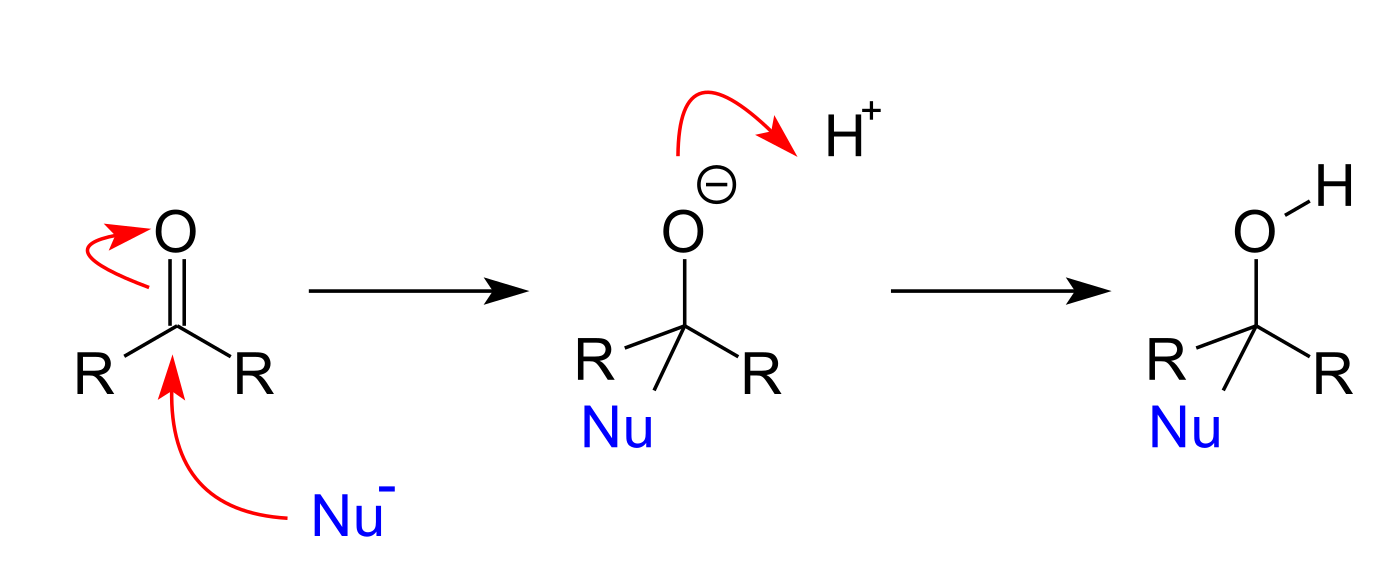
Many reactions of aldehydes and ketones involve nucleophilic addition.
The general pattern is:
- Nucleophile attacks carbonyl carbon.
- Electrons shift toward oxygen.
- Proton transfer restores neutrality.
Although many specific reactions exist, this pattern appears repeatedly throughout Organic Chemistry II.
Common Examples
Hydration
Addition of water.
Alcohol Formation
Reduction reactions.
Hemiacetals and Acetals
Important in carbohydrate chemistry.
Thinking About Carbonyl Reactions
Helpful questions include:
- Where is the electrophilic center?
- Which species acts as the nucleophile?
- How does resonance influence stability?
- Which intermediates are formed?
Self-Assessment
I can:
☐ Explain why the carbonyl carbon is electrophilic.
☐ Describe the general nucleophilic addition pattern.
☐ Distinguish aldehydes from ketones by relative reactivity.
☐ Recognize hydration, reduction, and hemiacetal/acetal formation as examples of nucleophilic addition.
Looking Ahead
Not all carbonyl compounds behave identically.
The next chapter explores carboxylic acids and their derivatives, where substitution rather than addition becomes the dominant theme.
Common Mistake — Memorizing Products
Common Mistake — Ignoring Polarity