Carbonyl Chemistry Chapter 13: Carboxylic Acids and Their Derivatives
Chapter 13: Carboxylic Acids and Their Derivatives
Substitution at the Carbonyl
Estimated reading time: 2 min
In this chapter
Introduction
Carboxylic acids and their derivatives represent another major family of carbonyl compounds.
These include:
- carboxylic acids,
- esters,
- amides,
- acid chlorides,
- and anhydrides.
Although these compounds differ in structure and reactivity, they share many common features.
Relative Reactivity
Some carbonyl compounds are more reactive than others.
In general:
Acid chlorides → Anhydrides → Esters → Amides
Understanding this trend helps explain many reaction pathways.
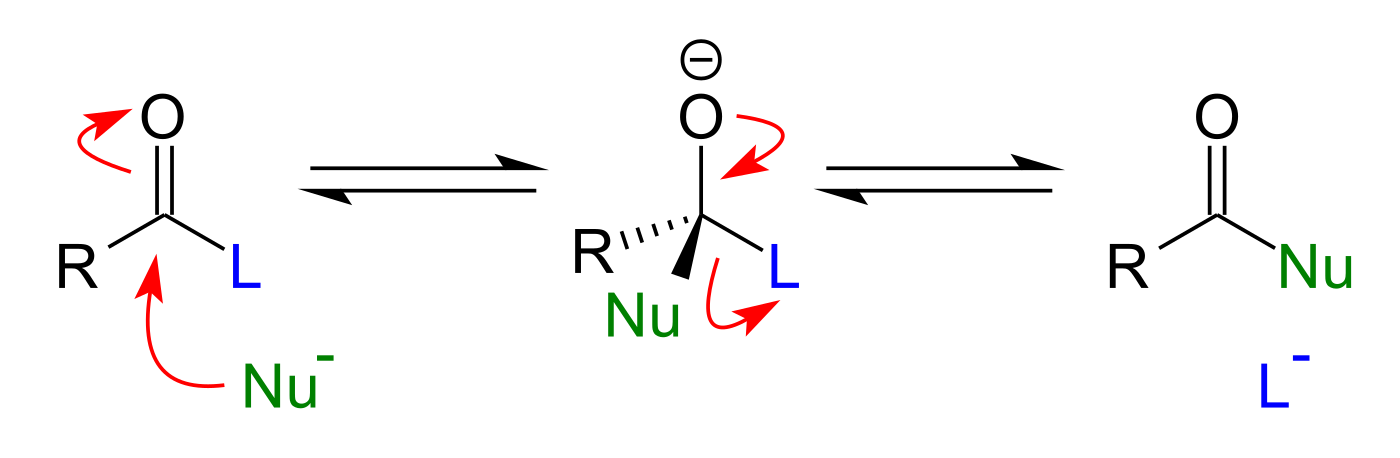
Nucleophilic Acyl Substitution
Unlike aldehydes and ketones, many carboxylic acid derivatives undergo substitution rather than simple addition.
The general pattern is:
- Nucleophilic attack.
- Formation of a tetrahedral intermediate.
- Departure of a leaving group.
This mechanism appears repeatedly throughout Organic Chemistry II.
Biological Importance
These functional groups are widespread:
Esters
Lipids and fats.
Amides
Proteins and peptides.
Carboxylic Acids
Fatty acids and metabolism.
Thinking About Reactivity
Helpful questions include:
- How good is the leaving group?
- Which derivative is more reactive?
- Which pathway is favored?
Self-Assessment
I can:
☐ Rank acid chlorides, anhydrides, esters, and amides by relative reactivity.
☐ Distinguish nucleophilic acyl substitution from nucleophilic addition.
☐ Describe the tetrahedral intermediate and leaving-group departure.
☐ Connect carboxylic acid derivatives to biological roles (esters in lipids, amides in proteins).
Looking Ahead
Carbonyl chemistry becomes even richer when reactions occur adjacent to the carbonyl group.
This introduces the chemistry of enols and enolates.
Common Mistake — Treating All Carbonyl Compounds Equally
Common Mistake — Ignoring Leaving Groups