Reference Functional Group Atlas Functional Group Interconversion Map
Functional Group Interconversion Map
Estimated reading time: 2 min
In this section
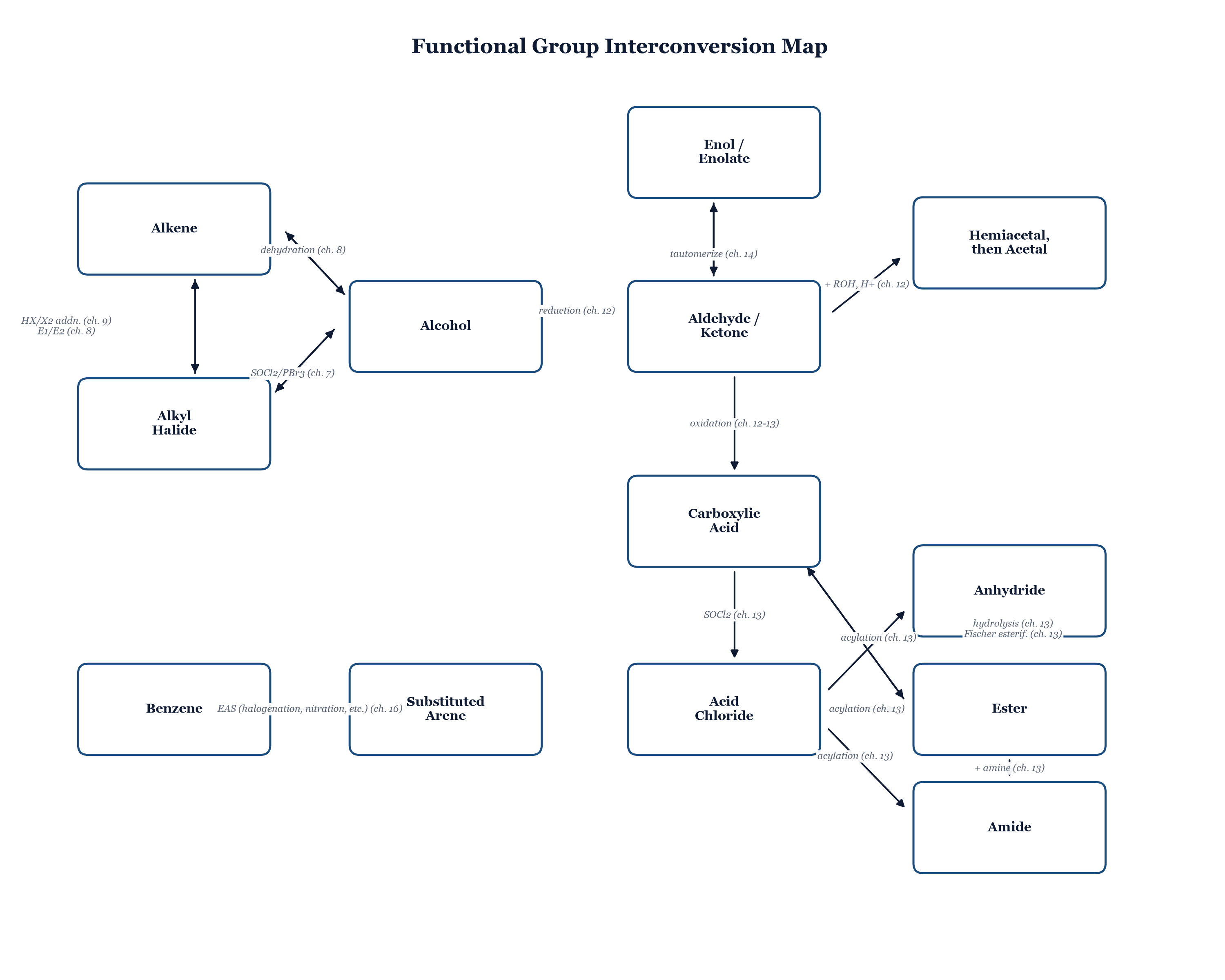
| Starting Group | Product | Typical Transformation | Chapter |
|---|---|---|---|
| Alkene | Alkyl halide | Electrophilic addition of HX or X₂ | 9 |
| Alkyl halide | Alkene | Elimination (E1/E2) | 8 |
| Alkyl halide | Alcohol | Substitution (SN1/SN2) with water or hydroxide | 7 |
| Alcohol | Alkyl halide | Substitution with SOCl₂, PBr₃, or acid + halide | 7 |
| Alcohol | Alkene | Acid-catalyzed dehydration (E1) | 8 |
| Alkene | Alcohol | Acid-catalyzed hydration (Markovnikov addition) | 9 |
| Alcohol | Aldehyde or ketone | Oxidation | 12 |
| Aldehyde or ketone | Alcohol | Reduction, or addition of a nucleophile | 12 |
| Aldehyde | Carboxylic acid | Oxidation | 12–13 |
| Aldehyde/ketone + alcohol | Hemiacetal, then acetal | Acid-catalyzed addition | 12 |
| Carboxylic acid | Acid chloride | Reaction with SOCl₂ | 13 |
| Acid chloride | Anhydride, ester, or amide | Nucleophilic acyl substitution | 13 |
| Ester | Carboxylic acid | Hydrolysis | 13 |
| Carboxylic acid + alcohol | Ester | Fischer esterification | 13 |
| Ester or acid chloride | Amide | Substitution with an amine | 13 |
| Ketone or aldehyde | Enol or enolate | Tautomerization, or deprotonation at the α-carbon | 14 |
| Benzene | Substituted arene | Electrophilic aromatic substitution (halogenation, nitration, sulfonation, Friedel-Crafts) | 16 |
Reading this table both directions is a useful exercise: given a target molecule, work backward through the map to identify which starting material and reaction would produce it — the core skill developed in retrosynthetic analysis (Chapter 21).