Refreshing General Chemistry Why Review General Chemistry? Molecular Geometry
Molecular Geometry
Estimated reading time: 1 min
In this chapter
In this section
Topics
- VSEPR theory
- Molecular shape
- Bond angles
What to Focus On
Focus on the geometries that appear most often in organic chemistry: tetrahedral (four groups around carbon), trigonal planar (three groups, as in a double bond), linear (two groups, as in a triple bond), bent (as in water, where two lone pairs compress the bond angle), and trigonal pyramidal (as in amines, where one lone pair does the same).
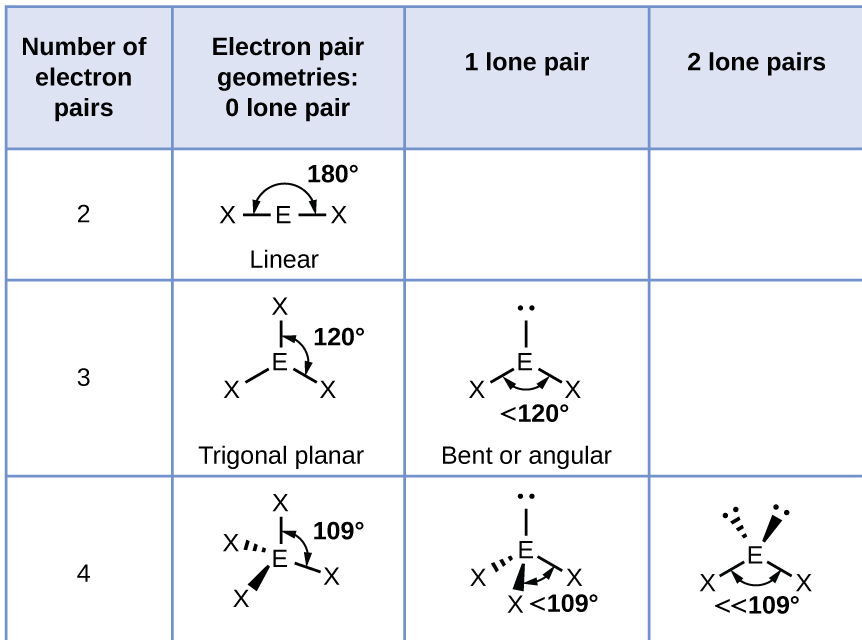
Lone pairs are worth special attention. They affect shape, but they also make atoms like oxygen and nitrogen reactive as nucleophiles — a concept that reappears throughout the course.
Why It Matters
Organic chemistry is inherently three-dimensional.
Shape determines properties and reactivity.
Recommended Resources
Reading
OpenStax Chemistry 2e
Videos
Gentle Exercises
Predict the geometry of:
- CH₄
- NH₃
- H₂O
- CO₂